![[Step back on the complete sequential path: Qualitative interpretation (link type: 'SEQ-BACK/essay-back/depends on; target: A05-m5ai)]](../icons/sq_back.gif)
|
![[Next step on the complete sequential path: Quantitative interpretation (link type: 'SEQ-NEXT'; target: A05-m5b)]](../icons/sq_next.gif)
|
![[Step back on the essay-path: Qualitative interpretation (link type: 'ESSAY-BACK/seq-back/depends on'; target: A05-m5ai)]](../icons/es_back.gif)
|
![[Next step on the essay-path: Quantitative interpretation (link type: 'ESSAY-NEXT'; target: A05-m5bi)]](../icons/es_next.gif) |
![[Show the characterisation of the module]](../icons/label.gif)
|
|
![[Show the navigation menu of the module]](../icons/nav.gif)
|
|
![[Show the Map of contents]](../icons/map.gif)
|
|
|
[Legenda] |
|
|
[Contents of the thesis] |
|
| [Comments] | |
|
|
|
|
|
|
|
|
|
|
|
|
|
|
|
|
|
|
|
[Legenda] |
|
|
[Contents of the thesis] |
|
| [Comments] | |
In the measured differential cross section of the chemi-ioniation reaction
M + X2  M+ + X- a small maximum is observed in the small-angle region, seen in all cross-section curves,
 |
|
||
![[Hide the details]](../icons/fold.gif) |
![[Compare with the classical interpretation (link type: IS COMPARED WITH/sq-back; target: A05-m5ai)]](../icons/Tm5a.gif) by a classical model stating the <general shape of the deflection curve as sketched in figure A05-m5aii-F2
by a classical model stating the <general shape of the deflection curve as sketched in figure A05-m5aii-F2
|
|
|
![[The equation is imported from the mesoscopic theoretical methods (link type: INPUT FROM/is elaborated in/wider range/project; target: MESO-m3c-defl)]](../icons/Tprojm3c.gif)
=.gif) |
(E1) |
Quantum mechanically this phenomenon can be explained by constructive interference of some
contributions, for instance the contributions of the two net
repulsive branches of the b- curve. Because of the nearly equal
slopes and about equal collision parameters of these branches at
small scattering angles, the wavelength of the interference is rather
long; a rough estimate has shown that the wavelength
has a value of a few degrees at the energies used, which is of the
same order of magnitude as the widths of the measured maxima.
curve. Because of the nearly equal
slopes and about equal collision parameters of these branches at
small scattering angles, the wavelength of the interference is rather
long; a rough estimate has shown that the wavelength
has a value of a few degrees at the energies used, which is of the
same order of magnitude as the widths of the measured maxima.
|
Quantum mechanically the simple addition of contributions to the
differential cross section according to Eq. (E1), i.e.
must be replaced by a
formula adding the scattering amplitudes. Especially in the case of
an interference structure with a long wavelength the differential
cross sections, calculated classically and quantum mechanically could
be very different. The composition of the steep ``repulsive'' branches
of the deflection curve (see Fig. A05-m5aii-F2)1 it is expected to give such a
long-wavelength structure on the differential cross section. Now we
shall give a rough estimation of this wavelength. Following the Ford
and Wheeler ![[(link type: `external/input from'; target: Rf(A05)12]](../icons/Textm1.gif) semiclassical treatment of the scattering amplitude
and using the notation of Bernstein semiclassical treatment of the scattering amplitude
and using the notation of Bernstein ![[(link type: `external/wider range/input from/elaborate'; target: Rf(A05)13)]](../icons/Textm3.gif) the amplitudes of the
contributions for repulsive scattering to the differential cross
section is given by the amplitudes of the
contributions for repulsive scattering to the differential cross
section is given by
where the indices 1 and 2 indicate the ``covalent'' and ``ionic'' contributions. The combined amplitude of these two contributions can be written by
From Fig. A05-m5aii-F2 it can be seen that the branches for net repulsive scattering have about equal values of b and about equal slopes  for a certain value of for a certain value of  .
Considering the relations .
Considering the relations
we conclude 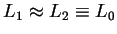 and
and  from which we obtain directly ![\begin{eqnarray*}f(\theta)&\simeq &\frac{1}{k}\bigg(\frac{L_0}{-2\eta_0^{\prime\...
...
\bigg(2\eta_{L_2}-L_2\theta-\frac{1}{2}\pi\bigg)\bigg]\bigg\}.
\end{eqnarray*}](f(th)approx.gif)
In an elementary way the intensity can be found as follows: ![\begin{eqnarray*}I(\theta )&=&\frac{2L_0}{-k^2\eta_0^{\prime\prime}\sin\, \theta...
...g[\eta_{L_{1}}-\eta _{L_2}-\frac{1}{2}\,\theta
(L_1-L_2)\bigg],\end{eqnarray*}](I(th)=2L.gif)
and, according to ,
![\begin{eqnarray*}I(\theta )&=&\frac{2L_0}{-k^2\eta_0^{\prime\prime}\sin\, \theta...
...{\mit\Theta}
}(l_2)\dr l-\frac{1}{2}\,\theta (L_1-L_2)\Bigg].
\end{eqnarray*}](I(th)=2Lint.gif)
Now we compare two scattering angles  and
and  .
Then the difference .
Then the difference
 in the argument of the cosine is given by:

Fig. A05-m5aii-F2 shows that in the interesting region the curves are about straight lines so we simplify the last equation into 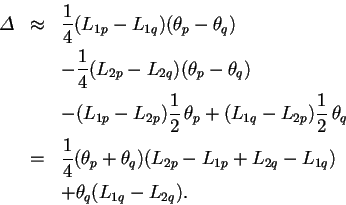
For two not very different scattering angles
and
we can
roughly estimate a value of
by
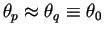 .
Then .
Then
Using the relation b= L/k (where  Å-1
for K + Br2 at 10.35 eV)
it can be seen graphically that at small positive scattering
angles the interference of these two contributions has a wavelength
of the order of a few degrees at colliding energies of about 10 eV. Å-1
for K + Br2 at 10.35 eV)
it can be seen graphically that at small positive scattering
angles the interference of these two contributions has a wavelength
of the order of a few degrees at colliding energies of about 10 eV.
|
|
|
Although we have only considered a two-contribution interference instead of four contributions, this interference can explain the observed bump in the differential cross section at small angle.
![[to the FULL figure]](../figs/A05F4_s.gif)
![[This figure is copied from the experimental Treated results (link type: INPUT FROM; target: A05-m4bi1)]](../icons/Tm4b.gif)
![[to the FULL figure]](../figs/A08F4_s.gif)
![\begin{eqnarray*}f_{1,2}(\theta)&=&\frac{1}{k(2\sin\, \theta
)^{1/2}}\bigg(\fr...
...ta _{\zs{L_{1,2}}}-L_{1,2}\theta
-\frac{1}{2}\,\pi\bigg)\bigg],\end{eqnarray*}](f_12.gif)
=1+2.gif)