![[Step back on the complete sequential path: Qualitative interpretation (link type: 'SEQ-BACK/is part of/is generalised in; target: A05-m5a)]](../icons/sq_back.gif)
|
![[Next step on the complete sequential path: Quantitative interpretation (link type: 'SEQ-NEXT/essay-next'; target: A05-m5aii)]](../icons/sq_next.gif)
|
![[Step back on the essay-path: Treated results (link type: 'ESSAY-BACK/depends on'; target: A05-m4bi2)]](../icons/es_back.gif)
|
![[Next step on the essay-path: Qualitative interpretation (link type: 'ESSAY-NEXT/seq-next'; target: A05-m5aii)]](../icons/es_next.gif)
|
![[Show the characterisation of the module]](../icons/label.gif)
|
|
![[Show the navigation menu of the module]](../icons/nav.gif)
|
|
![[Show the Map of contents]](../icons/map.gif)
|
|
|
[Legenda] |
|
|
[Contents of the thesis] |
|
| [Comments] | |
|
|
|
|
|
|
|
|
|
|
|
|
|
|
|
|
|
|
|
[Legenda] |
|
|
[Contents of the thesis] |
|
| [Comments] | |
We have tried to interpret measured cross sections with a simple classical atom-atom model for ion-pair formation in molecular collisions
![[The interpretation depends on the theoretical method (link type: `DEPENDS ON/detailed in/wider range/project'; target: MESO-m3c-mod)]](../icons/Tprojm3c.gif) . The transition
to the ionic state takes place via crossing of the neutral and ionic ground states. The electron transition probability is calculated applying the Landau-Zener approximation; trajectories are calculated using the impact parameter approximation.
. The transition
to the ionic state takes place via crossing of the neutral and ionic ground states. The electron transition probability is calculated applying the Landau-Zener approximation; trajectories are calculated using the impact parameter approximation.
At least qualitatively
the shape of the measured differential cross sections in
M + X M
and the equation for the differential cross section
M
and the equation for the differential cross section
=.gif) |
(E1) |
![[To the FULL figure]](../figs/FME_df_2.gif) | Figure A05-m5ai-F2:The deflection function. |
In order justify that statement, we compare as an example the measured
K + Br2 cross-section curve (figure. A05-m5ai-F1 ![[The figure is obtained from the Treated results (link type: INPUT FROM; target: A05-m4bi1]](../icons/Tm4b.gif) ) with that to be expected classically, assuming that the value of
Pb(1-Pb) does not change very much over the greater part of the b range; only in a very narrow region at
) with that to be expected classically, assuming that the value of
Pb(1-Pb) does not change very much over the greater part of the b range; only in a very narrow region at
 the ionization probability rapidly goes to zero.
For  eV degree the small differential cross section is due
to the two small contributions of net repulsive scattering where
eV degree the small differential cross section is due
to the two small contributions of net repulsive scattering where
 is small.
With decreasing  the classical rainbow angle where
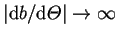 gives rise to the rainbow structure at
 ;
the minimum at
;
the minimum at
 is caused by the vanishing contribution for
because then
as well as Pb tend to zero.
is caused by the vanishing contribution for
because then
as well as Pb tend to zero.
On account of the large value of
around the inflection point on the
``covalent'' part of the deflection curve, a maximum is expected, seen indeed at
 .
.
At last it can be seen from the
curve that the small-angle
cross section consists of four small contributions; the polar
differential cross section in this region had to be at least two
times the large-angle value for ,
in agreement with the
measurements. However, the small maximum in this small-angle region,
seen in all cross-section curves, cannot be explained by this
classical model. (The small-angle errors mentioned above are not
important enough to cause the maxima.)
![[Compare the classical with the quantum interpretation (link type: IS COMPARED WITH; target: A05-m5aii)]](../icons/Tm5a.gif)
Thus the general shape of the measured differential cross section can indeed be explained using a simple classical harpoon model, except for small angles.
We assume that the value of
Pb(1-Pb)
does not change very much over the greater part of the b range; only in a very narrow region at
the ionization probability rapidly goes to zero. This assumption is justified ![[The justification is given in the Quantitative interpretation (link type: IS ARGUED IN; target: interpretation A05-m5bii]](../icons/Tm5b.gif) for
H12 = 4.5 x 10⁻² eV,
which is the estimated value for this system
for
H12 = 4.5 x 10⁻² eV,
which is the estimated value for this system
![[To the FULL figure]](../figs/A05F4_s.gif)