![[Step back on the essay-path: Quantitative interpretation (link type: 'SEQ-NEXT/essay-back/is part of/is aggregated in/is summarised in'; target: A05-m5b)]](../icons/sq_back.gif)
|
![[Next step on the complete sequential path: Quantitative interpretation (link type: 'SEQ-NEXT/essay-next/is used in'; target: A05-m5bii)]](../icons/sq_next.gif)
|
![[Step back on the essay-path: theoretical Treated results (link type: 'ESSAY-BACK'; target: A05-m4bii)]](../icons/es_back.gif)
|
![[Next step on the essay-path: Quantitative interpretation (link type: 'ESSAY-NEXT/out'; target: A05-m5bii)]](../icons/es_next.gif)
|
![[Show the characterisation of the module]](../icons/label.gif)
|
|
![[Show the navigation menu of the module]](../icons/nav.gif)
|
|
![[Show the Map of contents]](../icons/map.gif)
|
|
|
[Legenda] |
|
|
[Contents of the thesis] |
|
| [Comments] | |
|
|
|
|
|
|
|
|
|
|
|
|
|
|
|
|
|
|
|
[Legenda] |
|
|
[Contents of the thesis] |
|
| [Comments] | |
We calculate with a simple classical atom-atom model
![[The interpretation depends on the theoretical methods (link type: DEPENDS ON/detailed in; target: A05-m3c)]](../icons/Tm3c.gif) some potential parameters of the K-Br2 system by fitting calculated deflection functions with specific features of the measured differential cross section
some potential parameters of the K-Br2 system by fitting calculated deflection functions with specific features of the measured differential cross section
![[The interpretation depends on the theoretical methods (link type: DEPENDS ON/detailed in; target: A05-m4bi1)]](../icons/Tm4b.gif) , thus determining simultaneously the exact shape of the deflection function.
, thus determining simultaneously the exact shape of the deflection function.
The ionization deflection function can be calculated from the potential-energy curves
![[Details in a mesoscopic module (link type: IS DETAILED IN/wider range/project; target: MESO-m3c-defl)]](../icons/Tprojm3c.gif) . Choosing potential parameters by trial and error, the
scattering function has been calculated via fitting with the measured differential cross section for the
K + Br2 case by a new
method
. Choosing potential parameters by trial and error, the
scattering function has been calculated via fitting with the measured differential cross section for the
K + Br2 case by a new
method ![[The method this depends on is given elsewhere (link type: IS DETAILED IN/depends on/project; target: A06-m*]](../icons/Tprojm3.gif) . The numerical calculation of the classical deflection
angle is performed with a well-known error. For the calculation we
have used the crossing potential curves with the assumption that the
charge exchange occurs exactly at the crossing point.
. The numerical calculation of the classical deflection
angle is performed with a well-known error. For the calculation we
have used the crossing potential curves with the assumption that the
charge exchange occurs exactly at the crossing point.
Because the colliding particles are rather heavy and the kinetic energy is not very low, it will be reasonable to compare the measurements primarily with classical calculations. Small quantum-mechanical interference structures on the differential cross-section curves will be washed out by the large energy spread of the alkali beam, the averaging effect of the internal state distribution and the anisotropy of the halogen molecule, the extent of the crossing region and the finite angular resolution of the detector.
For the ionic-potential curve we have chosen a Rittner potential of the form :
| Uion(R) | = |  |
|
 |
|||
 |
(E1) |
 |
(E2) |
Because we use for the
ionic and covalent potential formulas many parameters we have looked
for effects in the differential cross section that are mainly due to
only one of these parameters. The parameters that can be determined
rather directly in this way are the endothermicity of the
collision
 ,
the polarizability of the bromine ion
,
the polarizability of the bromine ion
 ,
the crossing
distance Rc, the resonance energy H12, the repulsive steepness coefficient
,
the crossing
distance Rc, the resonance energy H12, the repulsive steepness coefficient  and the ionic-well depth
 .
.
Firstly
and the electron affinity of Br2 are determined via fitting of the relative shifts of the maxima and the small-angle deflection slopes of the deflection function at different energies with the measured shifts. They are found to be
=3.1 eV and
A (Br2) = 1.2 eV.
 |
|
![[Hide the details]](../icons/fold.gif) |
Then
is determined via fitting the scattering angle for collisions with b=RC with the measured minimum:
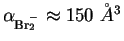 .
.
|
|
.gif) |
(E3) |
=3.1 eV, the value
 fits the calculated scattering angle for collisions with
b = Rc with the
measured minimum at
fits the calculated scattering angle for collisions with
b = Rc with the
measured minimum at
 .
The place of the minimum is only weakly
dependent on the value of
and a, but strongly dependent on the
value of
.
A theoretical value of the polarizability of K+ is
.
The place of the minimum is only weakly
dependent on the value of
and a, but strongly dependent on the
value of
.
A theoretical value of the polarizability of K+ is
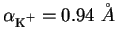
![[Input of that value (link type: INPUT FROM/external; target: R(A05)3)]](../icons/Textm4b.gif) , from which follows then
.
and
in the assumed potential, Rc can be determined to be Rc=
5.8 Å.
, from which follows then
.
and
in the assumed potential, Rc can be determined to be Rc=
5.8 Å.
|
Rc determinationAssuming the ionic potential is given by Eq.(E3)
and |
|
The well depth of the potential curve is determined using the classical rainbow angle:
= 1.8eV
|
|
|
The repulsive steepness coefficient is determined via a doubtful classical fit: = 0.3 Å
|
|
=.gif) |
(E1) |
 eV.degree,
but it does influence the decrease to the small value at
eV.degree,
but it does influence the decrease to the small value at
 .
Summarizing, the value of the cross section at
relative to the small values at
.
Summarizing, the value of the cross section at
relative to the small values at  > 50 and and the slope at
50&nbs,
in our classical consideration. However, it can be expected that the
difference between classical and quantum calculations could be large
especially for the quantitative calculation of the differential cross
section. Therefore the value of = 0.3 Å that gives the best
classical fit (supposing equal values of
for the covalent as well
as the ionic potential) is rather doubtful, in spite of the fact that
the classical calculated cross sections are very sensitive to the
value of .
At any rate the value = 0.3 Å for
K+ Br2 is a very
realistic one compared with other molecules with a known value of .
> 50 and and the slope at
50&nbs,
in our classical consideration. However, it can be expected that the
difference between classical and quantum calculations could be large
especially for the quantitative calculation of the differential cross
section. Therefore the value of = 0.3 Å that gives the best
classical fit (supposing equal values of
for the covalent as well
as the ionic potential) is rather doubtful, in spite of the fact that
the classical calculated cross sections are very sensitive to the
value of .
At any rate the value = 0.3 Å for
K+ Br2 is a very
realistic one compared with other molecules with a known value of .
The resonance energy is determined by fitting the curve height ratio and found to be H12=4.5 x 10¹² eV.
![[to the FULL figure]](../figs/A05F1_s.gif) |
Figure A05-m4bii-F2: K + BR2 ionic and covalent potential. |
|
H12 determinationThe differential cross sections of Fig. A05-m4bi1-F1
indicate equal total cross sections for chemi-ionization of
.
We have calculated the ratios R(120)/R(40) = 0.84
and
R(400) = 0.7 using the given
potential parameters and a resonance energy H12 = 4.5 x 10⁻² eV.
Of course there is the difficulty of the ambiguous  relation but
in the examples considered the scattering at
relation but
in the examples considered the scattering at
 has one
strongly dominating contribution and scattering at
has one
strongly dominating contribution and scattering at
 and
and
 has, respectively, four and two contributions with about equal values
of b. The ratio at
is the most important one for the
derivation of H12 because [on account of the flat long-range covalent
potential curve and the simple form of
the value of
R(120), where b is only a little bit smaller than
Rc, is only a
function of
and
.
A second point for the importance of
R(120) is, that this ratio is most sensitive with respect to the
variation of trial values of H12. The calculated ratios given above
are in very good agreement with the measurements. This method to fix
H12 seems to be rather sensitive: a resonance energy of
6.5x 10⁻² eV
would predict the quite different ratios 1.44, 0.95 and 0.73,
respectively. The value H12=4.5x 10⁻² eV is in rather good
agreement with the value of Ref. 1c which would be about
6x 10⁻² eV
if the same polarizability is taken.
has, respectively, four and two contributions with about equal values
of b. The ratio at
is the most important one for the
derivation of H12 because [on account of the flat long-range covalent
potential curve and the simple form of
the value of
R(120), where b is only a little bit smaller than
Rc, is only a
function of
and
.
A second point for the importance of
R(120) is, that this ratio is most sensitive with respect to the
variation of trial values of H12. The calculated ratios given above
are in very good agreement with the measurements. This method to fix
H12 seems to be rather sensitive: a resonance energy of
6.5x 10⁻² eV
would predict the quite different ratios 1.44, 0.95 and 0.73,
respectively. The value H12=4.5x 10⁻² eV is in rather good
agreement with the value of Ref. 1c which would be about
6x 10⁻² eV
if the same polarizability is taken.
|
|||
|
Summarizing, we have determined for the
K-Br2 system most of the
potential parameters; the missing parameters have been chosen
to construct the potential curves in Fig. A05-m5bi-F2 and the
deflection functions in Fig. A05-m5bi-F3 The values used are:
![\begin{eqnarray*}\Delta E&=&3.1 \mathrm{eV},\\
\alpha_{\zs\K^+}&=&0.94\ \AA^3\...
...(\mbox{\link{[(link type: \lq input from'; target: Rf(A05)4)]}} ),
\end{eqnarray*}](DeltaEarr.gif)
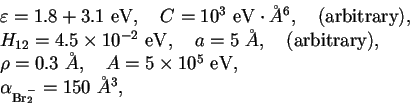 where the value for A has been fixed after the choice of C and a, by
requiring the ionic well minimum at -1.8 eV. For simplicity the Van
der Waals term and repulsive term of both potential curves are
supposed to be the same.
where the value for A has been fixed after the choice of C and a, by
requiring the ionic well minimum at -1.8 eV. For simplicity the Van
der Waals term and repulsive term of both potential curves are
supposed to be the same.
Based on the potential curves of the system, the classical deflection function is calculated
,
. For collisions with two channels, a covalent one and an ionic one
, the deflection function consists of a covalent and an ionic branch which are joined at the crossing radius Rc, as is shown in figure refA05-m5bi-F3, forming a closed deflection curve.
From the deflection function then, the differential cross section can be calculated ![[The deflection function is used for that purpose in the Quantitative interpretation (link type: `IS USED IN'; target: A05-m5bii)]](../icons/Tm.gif) .
.

 .
The part of the collision from the second passing of Rc
up to infinity we call purely inelastic scattering. The dashed curves
of A05-m5aii-F1 show for the two relevant different initial energies the
pure inelastic contribution to the total scattering angle, that is
the hypothetical deflection curve for particles following a straight
line until the second crossing where ionization takes place. As
already stated, this scattering angle as a function of b is a
contribution due especially to the inelasticity, irrespective of
whether the diabatic transition takes place in the incoming or in the
outgoing branch of the collision. The elastic contributions
can be found by subtracting the total and pure inelastic scattering
angle. Comparing the relative total scattering-angle shift and the
pure inelastic scattering-angle shift it is obvious that generally
the larger part of the former one is due not to the inelastic effect
but to the incorrectness of the
.
The part of the collision from the second passing of Rc
up to infinity we call purely inelastic scattering. The dashed curves
of A05-m5aii-F1 show for the two relevant different initial energies the
pure inelastic contribution to the total scattering angle, that is
the hypothetical deflection curve for particles following a straight
line until the second crossing where ionization takes place. As
already stated, this scattering angle as a function of b is a
contribution due especially to the inelasticity, irrespective of
whether the diabatic transition takes place in the incoming or in the
outgoing branch of the collision. The elastic contributions
can be found by subtracting the total and pure inelastic scattering
angle. Comparing the relative total scattering-angle shift and the
pure inelastic scattering-angle shift it is obvious that generally
the larger part of the former one is due not to the inelastic effect
but to the incorrectness of the
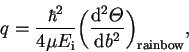
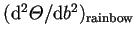 from the curve of A05-m5aii-F1, the rainbow
parameter q defined by
from the curve of A05-m5aii-F1, the rainbow
parameter q defined by
![[Arguments for the increase of the intensity of the supernumaries (link type: IS ARGUED IN/external; target: R(A05)10)]](../icons/Textm1.gif)
 eV.degree
on the
K+Br2
cross-section curve. A Rittner potential with a
minimum at - 1.8 eV gives the same calculated classical rainbow
angle.
eV.degree
on the
K+Br2
cross-section curve. A Rittner potential with a
minimum at - 1.8 eV gives the same calculated classical rainbow
angle. ![[to the FULL figure]](../figs/A05F7_s.gif)
![[These values agree with those in an earlier paper (link type: AGREES WITH/project; target: A03-m4b]](../icons/Tprojm4b.gif)
.gif)
 for the two energies. The
curve-height ratio does not give a value of the resonance energy H12
directly, because this ratio is also a function of the potential
curves. Eq. (E5) for the transition probability
for the two energies. The
curve-height ratio does not give a value of the resonance energy H12
directly, because this ratio is also a function of the potential
curves. Eq. (E5) for the transition probability

![[to the FULL figure]](../figs/A05F2_s.gif)