| << Previous | Index | Next >> | ||
 |
 |
 |
 |
 |
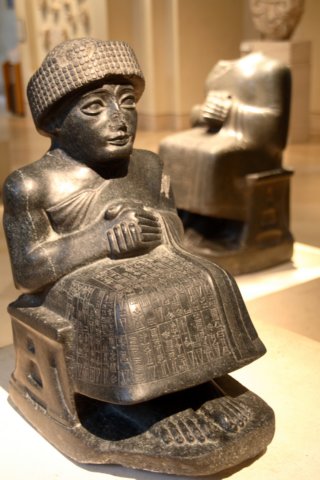
Paris, 20080302, Louvre: Gudea, prince de Lagash. Statue assise dédiée au dieu Ningishzida. Diorite. Vers 2120 av. J-C. Tello, ancienne Girsu.
The renewal of Sumerian Cities.
During the Third millennium, the Sumerian city-states Uruk, Lagash and Ur evolved amid constant conflict. The great kinds of Agade – Sargon, Narâm, Sin – brought disruption to an end by establishing a military-style empire between 2330 and 2150 BC. This power was shaken by the assault of the Guti, warriors descending from the Iranian mountains close by. The Sumerian cities, regained their independence and this period is known as the “neo-Sumerian” period. As archeologal fortune would have it, the Louvre collection preserves above all the memory of the Lagash dynasty.
The very pious Gudea, prince of Lagash
In the chaos and anarchy that arose following the invasion of the Guti, a new dynasty appeared at the head of the state of Lagash, the founder of which may have been the father-in-law of Gudea, Ur-Bau (a statue shows him in prayer). For almost 20 years (2141-2122 BC), Gudea (the name signifies “the destined”) ruled as ‘ensi’ (prince) over the state of Lagash and even beyond its frontiers. “One day when Ningirsu (the great god of Lagash) cast a benevolent eye on his city, his hand seized Gudea from the middle of the crowd and chose him to be the shepherd of men”. The Louvre possesses the majority of the statues of Gudea, a remarkable collection of statues in ronde-bosse from a regionwhere bas-relief was more developed. These statues almost always have a name and were intended to perpetuate the prince’s prayer before the divinities of the city. They are quite different from the small statuettes of orants dressed in the kaunakes from the dynastic archaic period. A certain affiliation on the other hand may be noticed with the art of Agade, a sober art combining the assured mastery of diorite stone working and a meticulous attention to detail in the costumes. The neo-Sumerian artists also excelled in sculpting diorite and lavished great care on the representation of the long smooth, fringed costume worn by the prince of Lagash. Perhaps Gudea took into his service sculptors from the imperial workshop of Agade. Whatever the case, Gudea seated or standing is always represented with his hands joined, dressed in a fine (perhaps linen), fringed material. He wears a cap with a turned brim (in wool or fur), the ultimate in princely or royal head dress. Gudea’s face is idealized - the portait of his youth can scarcely be distinguished from those of his maturity – more or less full but still very square and extremely severe: the sculptor has treated his eyelids in “fishbone” style.
Photo album created with Web Album Generator